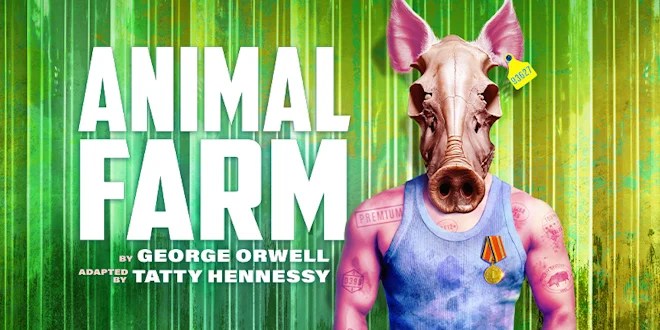
The night before I saw this production I had been to a show which had spawned a Netflix series, tonight I thought I might be in for the reverse, an Amazon Prime programme adapted for the stage. I quite like Jeremy Clarkson so was agog with anticipation. Not for the first time in my life was I mistaken. It just goes to show that I know Diddly Squat about George Orwell.
Actually, I am a fan of George Orwell, the opening paragraph being a way to provide a humorous start on a blank page, but the more I thought about it, the more it struck me that the basic premise is the same. Both Mr Clarkson and the animals took over a farm in order to improve their lives and, once they had done so, realised that they didn’t have a clue as to how to run it.
For some reason, I could never get into this book. I recall being made to read it at school but I think that my practical side precluded me from accepting that animals can do things which they obviously can’t, such as horses building a windmill, the blueprint of which has been drawn by a pig. Yes, I realise that it is a fable, in fact the original title was Animal Farm: A Fairy Story, but that didn’t help. I was also very young so didn’t appreciate the symbolism, and it seems that I am not the only one.

Everal A Walsh as Old Major
I would like to begin by saying that I thought the play was brilliant, being powerfully presented and acted. The opening consisted of a person, representing an animal, lying on the floor screaming, and finished in similar vein with very little relief, save for a pigeon, which, in the book was a spy and a spreader of disquiet in the neighbouring farms, who kept appearing on stage riding a scooter, to give a joke-laden resume to the audience of what we had just seen. It was delivered in an exaggerated Estuary accent, just in case we aynt bin payin’ attenshun.
I thought it interesting that the decision had been made to have the animals as humans, with labels and clothing to depict the species to which they belonged, rather than have the actors in animal costume. This made the more dextrous part of their performances a little easier to take – or ruined the analogy completely – depending on how you look at it.
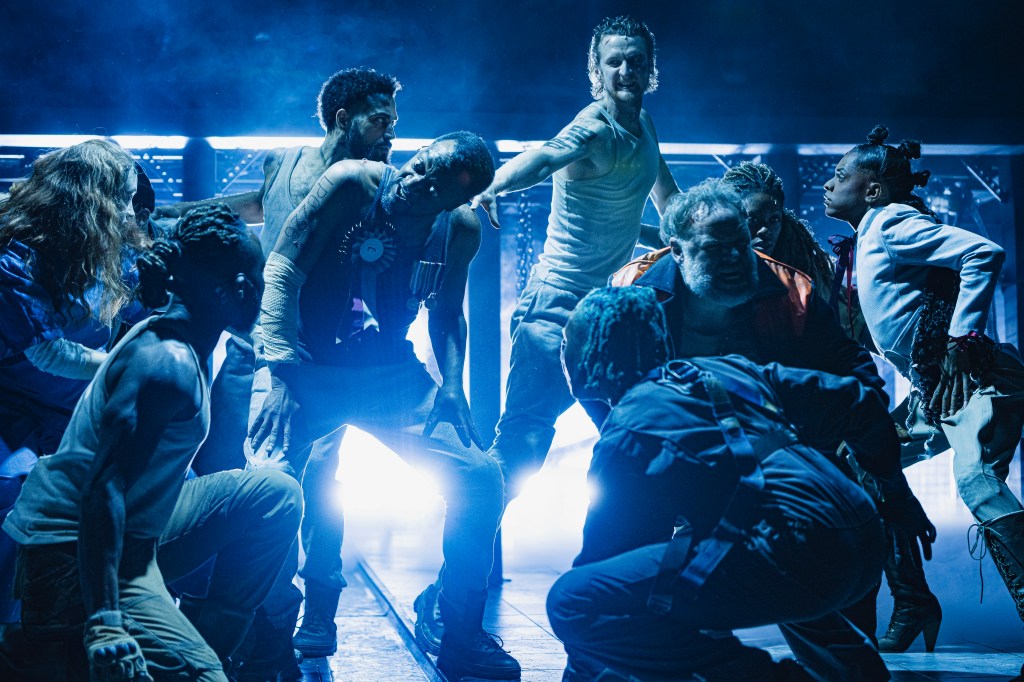
Robin Morrissey, white vest, as Snowball, being overthrown by the animals.
The plot is that a senior boar, Old Major, incites the animals on Manor Farm to organise a revolution against Mr Jones, farm owner and alcoholic, who has been abusing them by excessive work, hardly any food or shelter and a beating should they slow down. Old Major also teaches them a battle song called Beasts of England. When he dies, a couple of young pigs, Snowball and Napoleon, assume command and put his plan into action. They manage to drive Mr Jones off his farm and proceed to run it themselves, although, as previously stated, they have no idea of what to do. They do, however, rename the property, Animal Farm.
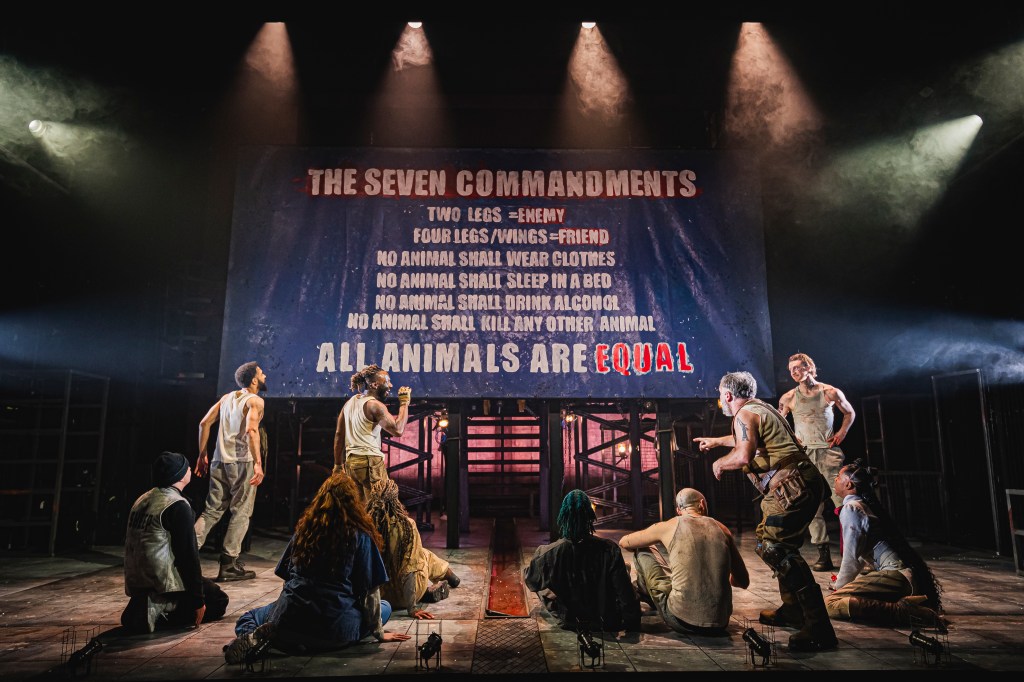
Snowball is the dominant partner and teaches the animals to read and write, well, most of them, and formulates a constitution comprising Seven Commandments. He also proposes monthly meetings to discuss policy. After an unsuccessful attempt by Mr Jones to retake the farm, Snowball designs a windmill, which he says will provide power for the animals, giving them heat and easing their work burden. Napoleon, feeling somewhat left out, criticises the idea and begins to undermine Snowball. He is being subtly manipulated in this subterfuge by Squealer, another pig, who remains stealthily in the background. The animals turn against Snowball and Napoleon’s dogs chase him from the farm. Napoleon assumes control, declaring himself Supreme Leader, and abandons all vestiges of democracy. He also resurrects the plan for the windmill, declaring it to be his idea.

Left to Right: Gabriel Paul (Boxer), Tianah Hodding (Clover), Tachia Newall (Napoleon), Tom Simper (Squealer) and Joshua-Alexander Williams (Blue)
Over time, the commandments are amended to suit Napoleon’s actions and, now ensconced in the farmhouse, after amending Commandment 4 by adding ‘with sheets’ to the end, oversees the construction of the windmill, which, once working, is destroyed in a storm. The repaired version is then blown up by a neighbouring farmer who invades the farm, sparking a battle in which Boxer, the horse, who does all the heavy work, is injured. Napoleon places the blame on Snowball and a purge of animals accused of helping him takes place. The anthem, Beasts of England, is replaced by one called Animal Farm, which extolls the virtue of Napoleon.

Brydie Service as Clara the hen and Tiannah Hodding, Clover.
Although Boxer survives, he is badly wounded and Napoleon organises an ambulance to take him to the vets, but some time later conveys the news to the others that he has died. In fact it wasn’t an ambulance but a butcher’s van which took Boxer away, Napoleon having sold the carcass to get money so that he, and his cohorts could buy whiskey, having expunged Commandment 5.
It transpires that Napoleon has also been selling eggs to a human, thus the circle of the story is completed by his hosting of a banquet with the local farmers and traders, while the animals who are not members of the inner circle, watch from outside in conditions worse than those at the beginning.

Em Prendergast as Milo the pigeon, sans scooter.
The set, by Hayley Grindle, who also designed the costumes, was sparse, comprising a raised rectangular, glass-fronted room where the farmer, and later, Snowball, Napoleon and Sqealer lived. The rest was a series of cages in varying sizes and shapes, which were where the animals slept, and, when moved around, doubled as metaphors for hard work. There was also a channel running from the back to the front of the stage, used as a feeding trough and then, running with blood, to symbolise the death of a beast without actually showing it.

Gabriel Paul as Boxer and Farshid Rokey, Minty the sheep, complete with fleece and woolly hat.
The costumes were colour coded, in various shades of dirty, to identify the animal depicted: the pigs wore white vests and grey joggers. The sheep, Minty, wore a fleece, and, if you thought that was corny, Benjamin sported a donkey jacket! In case you didn’t get it, the animal’s breed was either written on their clothing or painted on a body part.
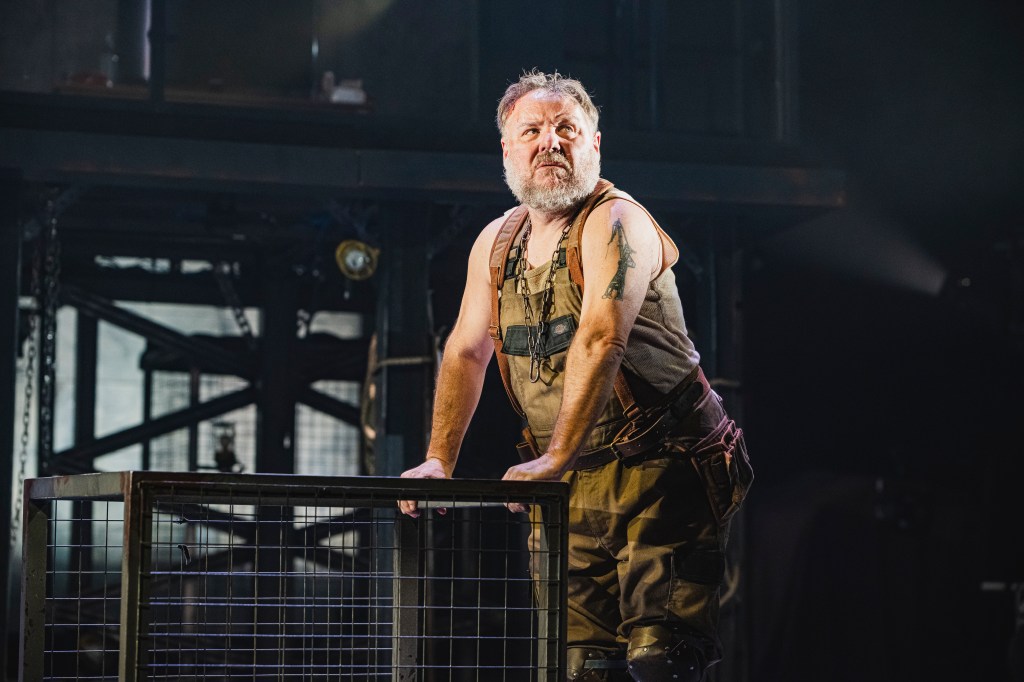
David Nellist, as Benjamin, minus donkey jacket, but still a donkey.
The lighting, by Jai Morjaria, was very dramatic – except for the pigeon interludes which were usually in sunshine away from the farm – with a uniformly dim, cold, dark aura contrasting with the warm glow emitting from the farmer’s house, above, which also contained a panel tv occasionally showing a burning fire to add to the effect.
Sound Design and Composition was by Khalil Madovi, whose score, added a further layer to the doom, as did the occasional loud crash and bang.

Kaya Ulasli (Mr Jones) in cosy flat, with pig’s head trophy and bottle.
You might be wondering why I have not mentioned any of the actors by name. The reason is that this is an ensemble piece and there were thirteen of them, every one superb, so, in the original spirit of the farm, I will adopt the philosophy that all actors are equal. I have managed to include them all in the photographs. Another thing I have kept quiet about is that several of them are living with disabilities. I have previously written that, as the audience pay with their hard earned cash, they should be rewarded with productions being as near perfect as possible, no explanations, no allowances and no excuses, this evening we were.
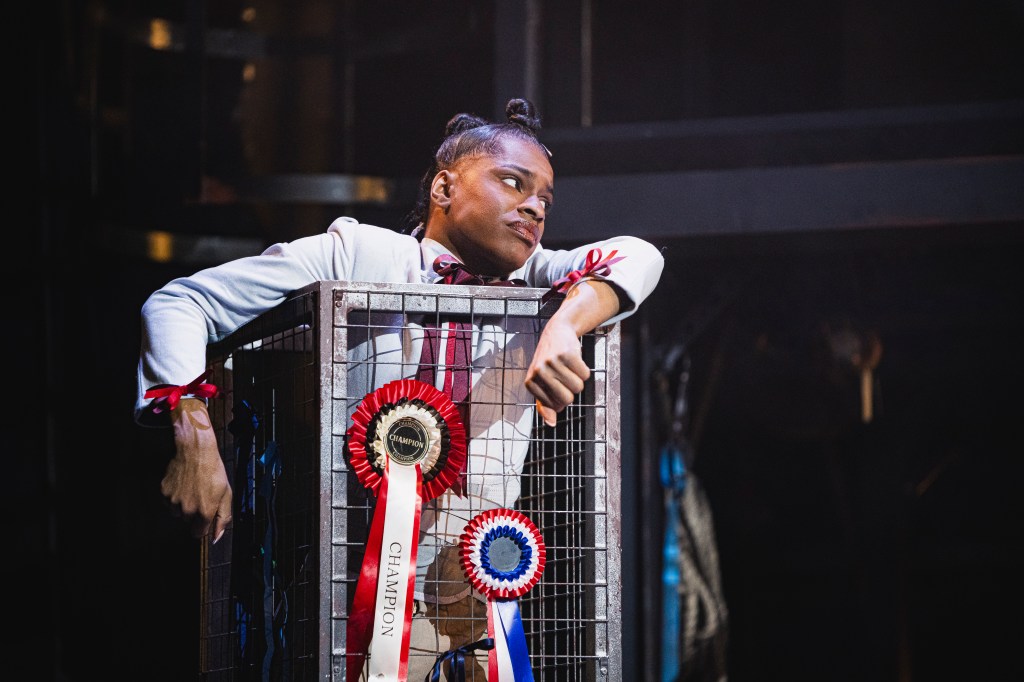
Shakeel Kimotho as Mollie.
I would highly recommend you go see this drama, but please take it for what it is, a commentary on the human condition, and how the most well intentioned plans can be ruined by greed and corruption. Please be aware, however that it misses the point which George Orwell was making. Should you be happy with that as a review then click on the links below to get your ticket. If you would like my explanation why it misses the point, please read on.
Animal Farm is at Leeds Playhouse until 29th March. For more details and to book, please go to https://www.leedsplayhouse.org.uk/event/animal-farm/
For all Leeds Playhouse productions it is https://www.leedsplayhouse.org.uk/
Featured image from Leeds Playhouse. Photographs by Kirsten McTernan
I have come to accept that classics from English literature will be ‘adapted’ by Leeds Playhouse, or anywhere nowadays, sometimes to the point where I wonder how far you can deviate from an original whilst still keeping the title. The programme notes on this work concerned me more than most.
The first paragraph, by Director, Amy Leach, outlines how the world has changed since the book was published in 1945, and so it has. The examples given were: nations regrouping after the war, the formation of the UN, the division of Korea and French women being given the vote. She then goes on to say that Tatty Hennessy, who wrote this adaptation, ‘doesn’t share the original author’s preoccupation with the Russian Revolution and the rise of Stalinism’.
What they fail to realise is that, although not published until August, 1945, it was written between November 1943 and February, 1944, when the Second World War was at its height. On 12th July, 1941 the UK had formed an alliance with the Soviet Union, ruled by Stalin, when it was invaded by Germany. The USA didn’t enter until after the bombing of Pearl Harbour in December of that year. Orwell’s ‘preoccupation’ was his loathing of our joining forces with a country run by one tyrant, to fight another, similarly ruled. Animal Farm was his attempt to bring this to the notice of the general public, who, in order to keep them on board, were still led to believe that Stalin – nicknamed Uncle Joe by Western media – was a fairly benevolent chap. Even though the UK and US were aware of some of his atrocities at the time, it wasn’t discovered until well after the war just how unspeakable and widespread they had been.
Animals weren’t used because George Orwell wanted to be Beatrix Potter, there was censorship imposed during the war to maintain morale, so using real names for the characters would have meant the book would probably never have been published. The humans in the book are us, the West, consorting with the USSR so, even when the war was over, it might still have been suppressed while the delicate negotiations to allocate countries to the victors were in progress.
As a piece of work dealing with inequality and the way in which, even those with the best intentions can become corrupt, the play is great, but it does a huge disservice to the ‘original author’ by transforming an exposé of our association with systemised state torture and mass murder, to make a point about factory farming. It had nothing to do with animals per se, and to compare it with ‘big retail warehouses where faceless industry treats people as a commodity – a number on a spreadsheet – rather than as human beings.’ I find disgraceful. I would rather be a number printed on a spreadsheet at an Amazon warehouse to roster my shift, than have it tattooed on my arm in a concentration camp to allocate my death slot.
Rant over.
 Tyke It To The Limit